Motion Capture: What It Actually Adds to an Animation Pipeline
📌 Table of Contents
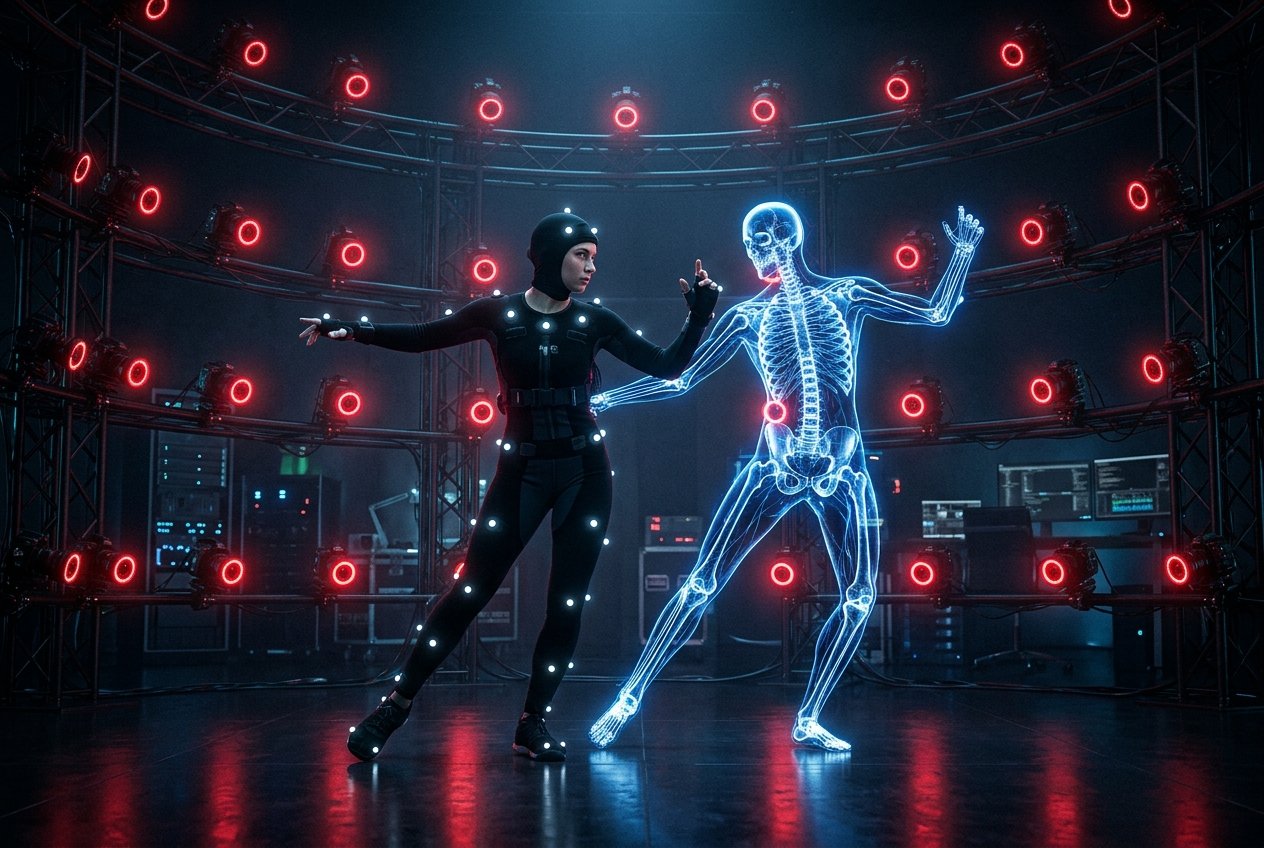
Motion capture (mocap) records real human movement — using body suits, cameras, or increasingly, markerless AI-based systems — and translates it onto a 3D character's rig. It's used across film, games, and virtual production, but it's widely misunderstood by students as a technology that removes the need for animators. In practice, it changes their job rather than eliminating it.
How a mocap pipeline works
A performer wears a suit fitted with reflective markers (in traditional optical systems) or is tracked directly by depth cameras and AI pose-estimation (in markerless systems). Cameras around a capture volume triangulate marker positions, producing raw positional data. This data is then **cleaned and retargeted** — mapped onto the proportions of the 3D character's rig, which rarely matches the performer's body exactly, and any jitter, marker swaps, or tracking errors from the capture session are manually fixed.
Why raw mocap is never final
Raw motion capture data is rarely usable straight out of the system. Retargeting introduces foot-sliding, clipping, and proportion mismatches that need manual correction. More importantly, mocap only captures what the performer physically did — it can't add exaggeration, timing changes for comedic or dramatic effect, or camera-driven adjustments the performer couldn't see while recording. This is where **mocap cleanup animators** — a real and distinct job title in game and film studios — take over, hand-animating on top of the captured data to make it work for the shot.
Where it's used
Mocap dominates large-scale game production (crowd animation, combat systems, NPC behavior) because it can generate large volumes of believable motion far faster than hand-keyframing every cycle. It's also central to modern virtual production, letting directors see a performance driving a digital character live on set. Film uses it selectively — often for creature or non-human characters (a technique popularized by Weta Digital) where an actor's performance needs to be translated onto a completely different body.
The skill that's actually in demand
Understanding retargeting workflows, cleanup techniques, and how to blend mocap with hand-keyed animation is a genuinely marketable skill distinct from either pure mocap operation or pure hand-animation. Studios increasingly want animators who are comfortable in both worlds — capable of directing a mocap session, cleaning the resulting data, and then hand-animating the shots (like close-up facial performance) where mocap alone isn't enough.
For students, the takeaway is that mocap is a tool that shifts effort from raw keyframing toward editorial and performance judgment — not a shortcut that removes animation skill from the pipeline.