Pixar's Workflow Explained: How a Feature Actually Gets Made
📌 Table of Contents
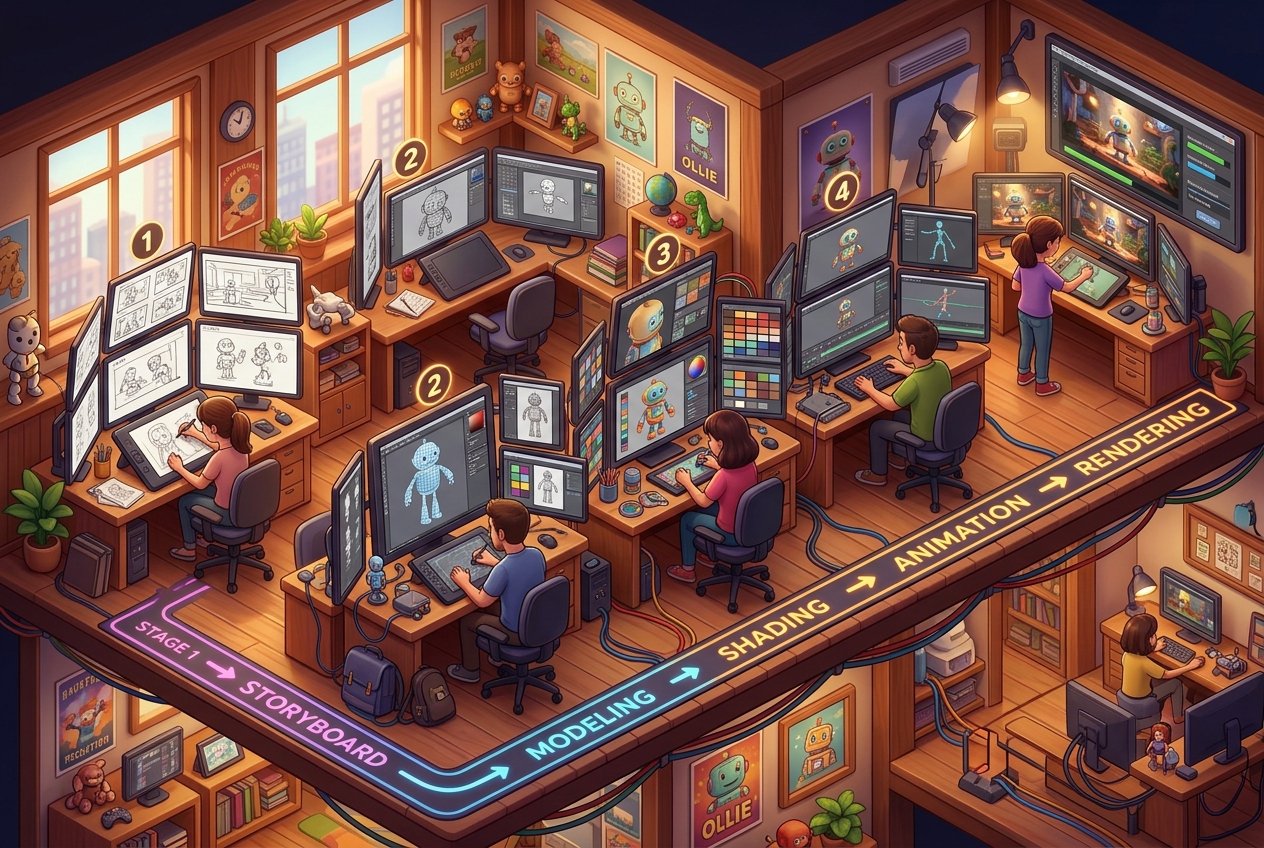
Pixar's films look effortless on screen, but every one of them passes through a rigorous, well-documented production pipeline that most 3D animation studios worldwide — including Indian ones — have adapted in some form. Understanding this workflow gives students a realistic map of what a career in feature animation actually looks like, stage by stage.
Story and previsualization
Every Pixar film begins as story reels — rough sketches edited to a scratch soundtrack, essentially a moving storyboard. This stage can be rewritten dozens of times before a single frame of "final" animation is built, because fixing story problems here is far cheaper than fixing them after full production. Previs artists then block out camera moves and staging in simple 3D to test whether sequences actually work in space.
Modeling, rigging, and surfacing
Once a sequence is greenlit, character and set modelers build production-ready geometry, which is handed to riggers who build the skeleton and control systems animators will act with. Surfacing artists then texture and shade every asset — a process that at Pixar's scale involves specialized teams just for skin, cloth, hair, and environments, each with dedicated technical directors.
Layout and animation
Layout artists translate the previs camera work into final, precise staging within finished sets. Animators then take over, working shot by shot — often spending a full week or more polishing a few seconds of character performance. Pixar animators work in "blocking" (rough poses) before moving to "polish" (smooth, believable motion), a two-pass approach widely taught in animation courses because it mirrors how professional pipelines actually work.
Simulation, lighting, and rendering
Cloth, hair, water, and other secondary effects are handled by simulation artists using specialized software, followed by lighting artists who set mood and depth for every shot. Rendering — historially done with Pixar's own RenderMan — is the final computational step that can take hours per frame at feature quality, run across large render farms.
What students should take from this
The single biggest lesson from Pixar's pipeline isn't the software — it's the specialization. Nobody at Pixar does "everything." Successful careers are built by getting genuinely excellent at one stage (modeling, rigging, animation, lighting) while understanding enough of the surrounding stages to collaborate well. Students entering 3D animation training should treat their coursework the same way: build broad literacy across the pipeline early, then specialize hard once they know which stage excites them most. A portfolio that shows depth in one discipline — rather than shallow competence in all of them — is what studios, Pixar included, actually hire for.