Understanding a USD Workflow in Modern 3D Production
📌 Table of Contents
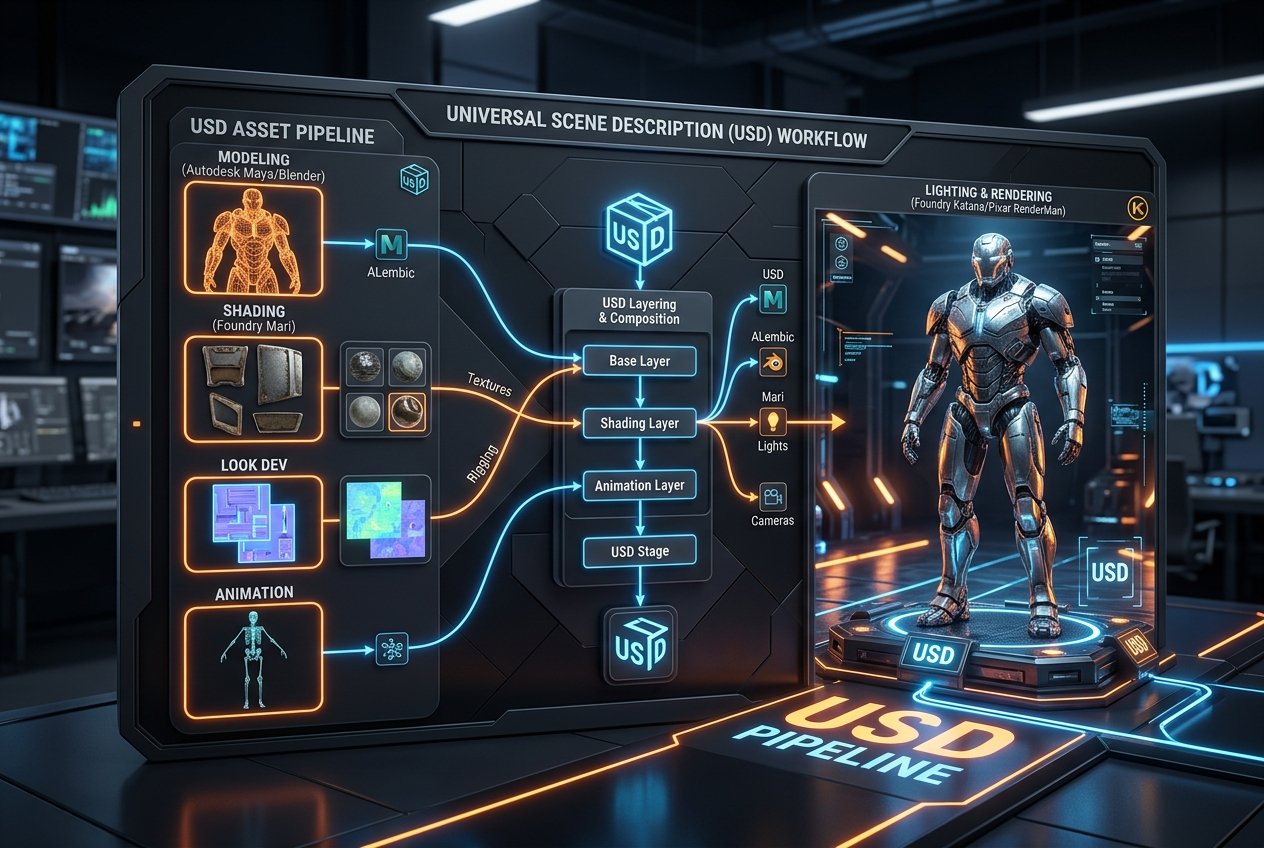
Universal Scene Description (USD) has quietly become one of the most important pieces of technology in modern VFX and game production, even though most students never encounter it directly in beginner tutorials. Understanding what a USD-based workflow actually looks like in a studio is valuable context for anyone aiming at a VFX or 3D modeling career beyond entry-level.
What USD actually is
USD is a file format and framework, originally built by Pixar for their own internal pipeline, that describes complex 3D scenes — geometry, materials, lighting, cameras, animation — in a way that's efficient, non-destructive, and designed for large teams to work on simultaneously. Pixar open-sourced it in 2016, and it has since been adopted as a near-universal standard across major studios and, increasingly, software vendors including Autodesk, SideFX, and Epic Games.
Why "non-destructive layering" matters
The feature that sets USD apart from older scene formats is **layering and composition**: instead of one artist's edits overwriting another's, USD lets multiple layers of a scene exist simultaneously and combine according to defined rules — a lighting artist's layer, an animator's layer, a set-dressing layer — without any of them permanently altering the others' work. This is what makes large, distributed productions with hundreds of artists touching the same scene actually manageable.
Referencing instead of duplicating
A related concept, **referencing**, lets a scene point to an asset (say, a tree model) rather than embedding a full copy of it. If the tree model is updated, every scene referencing it updates automatically — critical for productions with thousands of repeated assets (a forest, a crowd, a city block) where duplicating full geometry everywhere would be unworkable.
Where students will encounter USD
USD workflows show up in Houdini (which has deep native USD support, often used for look-development and lighting), in Pixar's own RenderMan pipeline, increasingly in Unreal Engine for virtual production, and across NVIDIA's Omniverse ecosystem. Studios doing high-end VFX, animated features, or large game environments are increasingly likely to be built around USD as their core scene format rather than software-specific proprietary formats.
Practical advice for students
Rather than trying to "learn USD" as an isolated topic, the more useful approach is to build familiarity with it inside a tool that has strong native support — Houdini is the most commonly recommended entry point for VFX students specifically because its Solaris/LOPs context is built entirely around USD concepts. Even conceptual understanding of layering, referencing, and composition — the "why," not just the "how" — gives students a real advantage when interviewing for pipeline-aware VFX or lighting roles.