MetaHuman Creator: A Practical Guide for Game Art Students
📌 Table of Contents
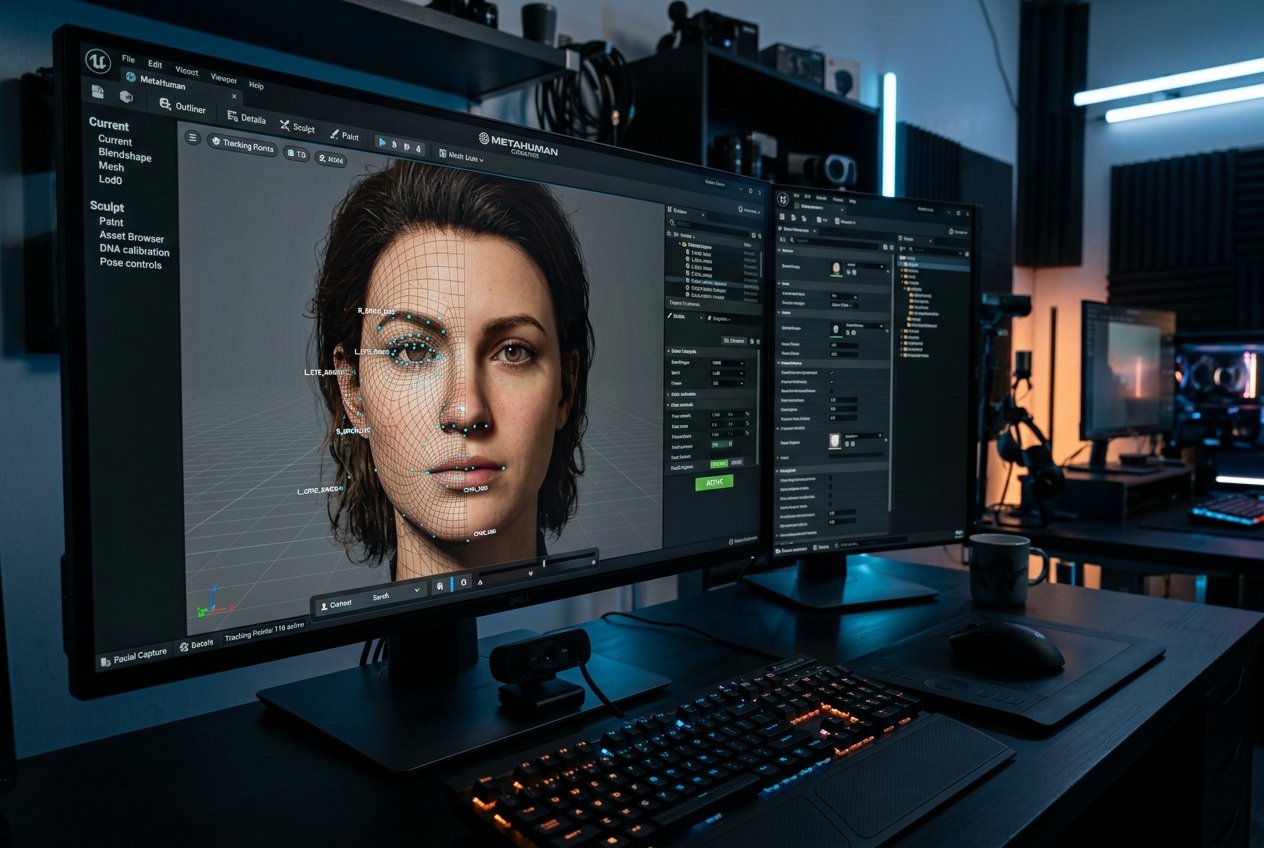
MetaHuman Creator, Epic Games' free tool for building highly realistic digital humans, has become one of the fastest ways for students and studios alike to get production-quality characters into Unreal Engine — without needing years of dedicated character-art specialization to get a believable result.
What it actually does
MetaHuman Creator lets users build a fully rigged, realistic human character through a browser-based or Unreal-integrated interface — blending and adjusting facial features, body types, skin, hair, and clothing from a library built on real scan data. The output isn't just a static model: it comes with a production-grade facial rig capable of a full range of expression, compatible with motion capture, Audio2Face-style AI animation, and Unreal's real-time rendering — meaning a usable digital character that would traditionally take a specialized team weeks to build can be assembled and customized in hours.
Why this matters for the industry, not just hobbyists
Before MetaHuman, building a photorealistic digital human required a dedicated pipeline — scanning, specialized modeling, custom rigging — that only large studios could justify. By making this accessible for free within Unreal's ecosystem, Epic effectively democratized a capability that used to be a competitive advantage of only the biggest VFX and game studios. Indie developers, smaller studios, and student projects can now include believable human characters that would previously have been out of reach.
What students should still learn
MetaHuman removes the need to build a photorealistic human rig from scratch, but it doesn't remove the need to understand what makes a rig work well. Students still benefit enormously from understanding facial anatomy, blendshape logic, and animation principles — because customizing a MetaHuman convincingly (adjusting expressions, integrating custom animation, art-directing a performance) requires exactly that knowledge. Treating MetaHuman as a shortcut around learning character fundamentals tends to produce technically functional but creatively flat results.
Practical uses beyond hero characters
Beyond lead characters, MetaHuman is widely used for background NPCs, virtual production stand-ins, prototyping, and increasingly for non-entertainment applications like virtual presenters and enterprise avatars — meaning familiarity with the tool has value beyond games specifically.
Building a portfolio with it
For students, a strong approach is using MetaHuman as a base and then demonstrating real skill on top of it — custom animation, integration into a game or cinematic scene, or believable performance work — rather than showing an unmodified default character. Studios reviewing portfolios can tell immediately whether a MetaHuman was customized thoughtfully or just dropped into a scene, and the former is what actually demonstrates hireable skill.