The Future of AVGC Careers in India: What the Numbers Actually Show
📌 Table of Contents
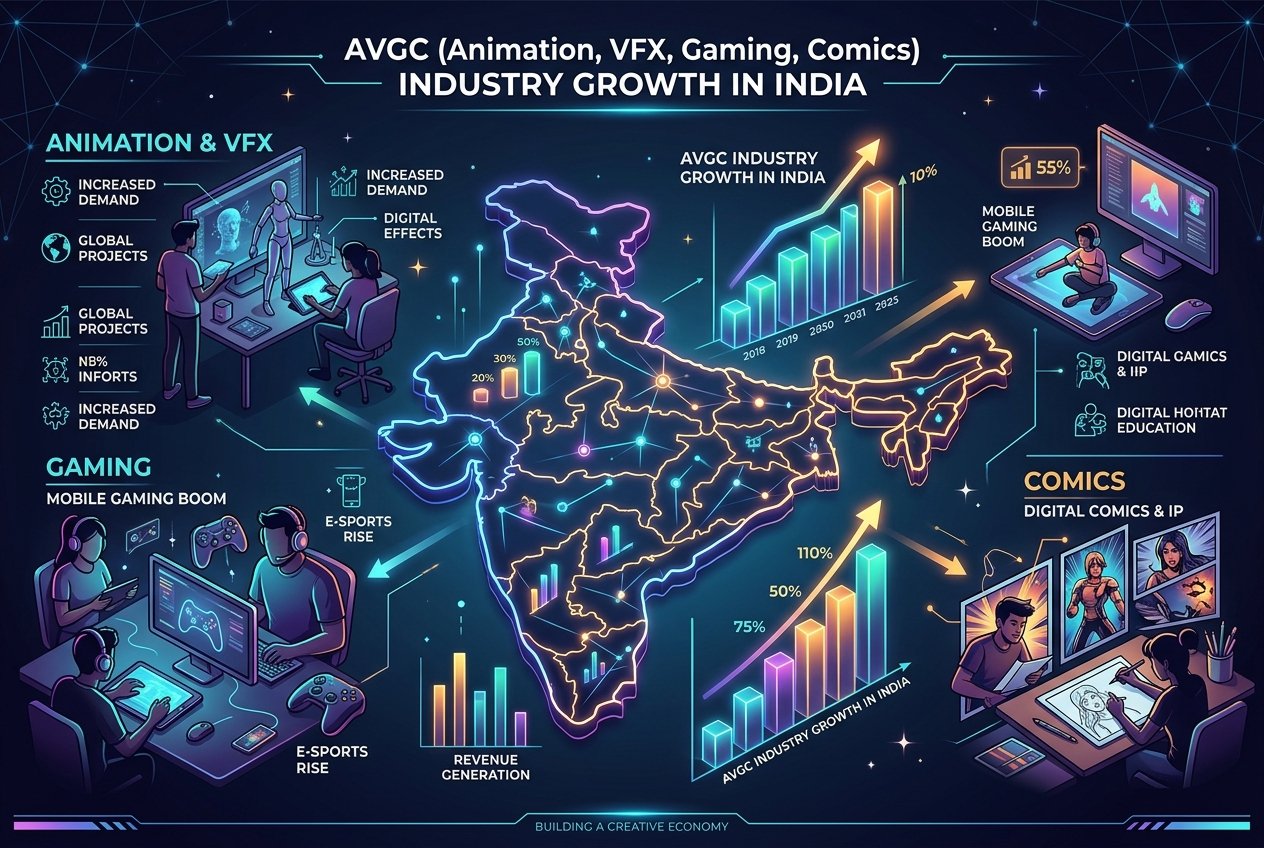
India's Animation, Visual Effects, Gaming, and Comics (AVGC) sector has moved from a niche creative field to a formally recognized pillar of national economic policy — and the scale of investment now backing it gives students a genuinely data-grounded reason to take this career path seriously.
The government has put real numbers behind it
The Union Budget 2026-27 formally positioned AVGC under India's "Orange Economy" umbrella, with the Ministry of Information and Broadcasting confirming an INR 250 crore allocation to establish AVGC Content Creator Labs across roughly 15,000 secondary schools and 500 colleges nationwide. Government and industry projections consistently point toward the sector needing between 20 lakh and 23 lakh direct and indirect professionals by 2030-2032, with the overall AVGC-XR market projected to reach $20-26 billion by 2030. State-level policy has followed — Maharashtra alone approved a ₹3,268 crore AVGC-XR policy, with Karnataka, Tamil Nadu, Madhya Pradesh, Telangana, and others building their own initiatives.
Why this matters beyond the headline numbers
Large government investment in a sector typically has two practical effects for students: it funds new training infrastructure (the Indian Institute of Creative Technologies in Mumbai, operational since mid-2025, has already launched 18 courses), and it signals to global studios that India is being positioned as a stable, long-term production destination rather than a temporary cost-saving outsourcing option — which affects the kind of work (original IP development, not just service work) that flows into the country over time.
Where the growth is concentrated
Industry hiring data points to the fastest growth in roles that combine traditional creative skill with new technology fluency — AI-assisted animation, real-time 3D (game engines used beyond games, in virtual production and simulation), and XR development. Tools most in demand include Unity and Unreal Engine for games and XR, Blender and Maya for 3D art, and increasingly AI-assisted tools like Runway and Kling layered onto traditional animation skill.
Talent gap, not oversupply
Multiple industry analyses describe India's AVGC sector as facing a genuine talent gap relative to demand, not an oversaturated job market — a meaningfully different situation from more mature creative job markets internationally where entry-level competition is fiercer. This gap is precisely why government policy is focused on rapidly scaling training infrastructure rather than managing an oversupply of graduates.
What this means for students starting now
A student entering AVGC training today is doing so during a period of active infrastructure-building rather than at the tail end of a hype cycle — schools, labs, and formal industry-education partnerships are actively being built out through 2026 and beyond. Combining strong fundamentals in one specialization (animation, VFX, game art, or design) with genuine comfort in AI-assisted tools positions students well for the specific direction India's AVGC growth is heading.