Blackmagic Fusion: A Serious Compositing Alternative
📌 Table of Contents
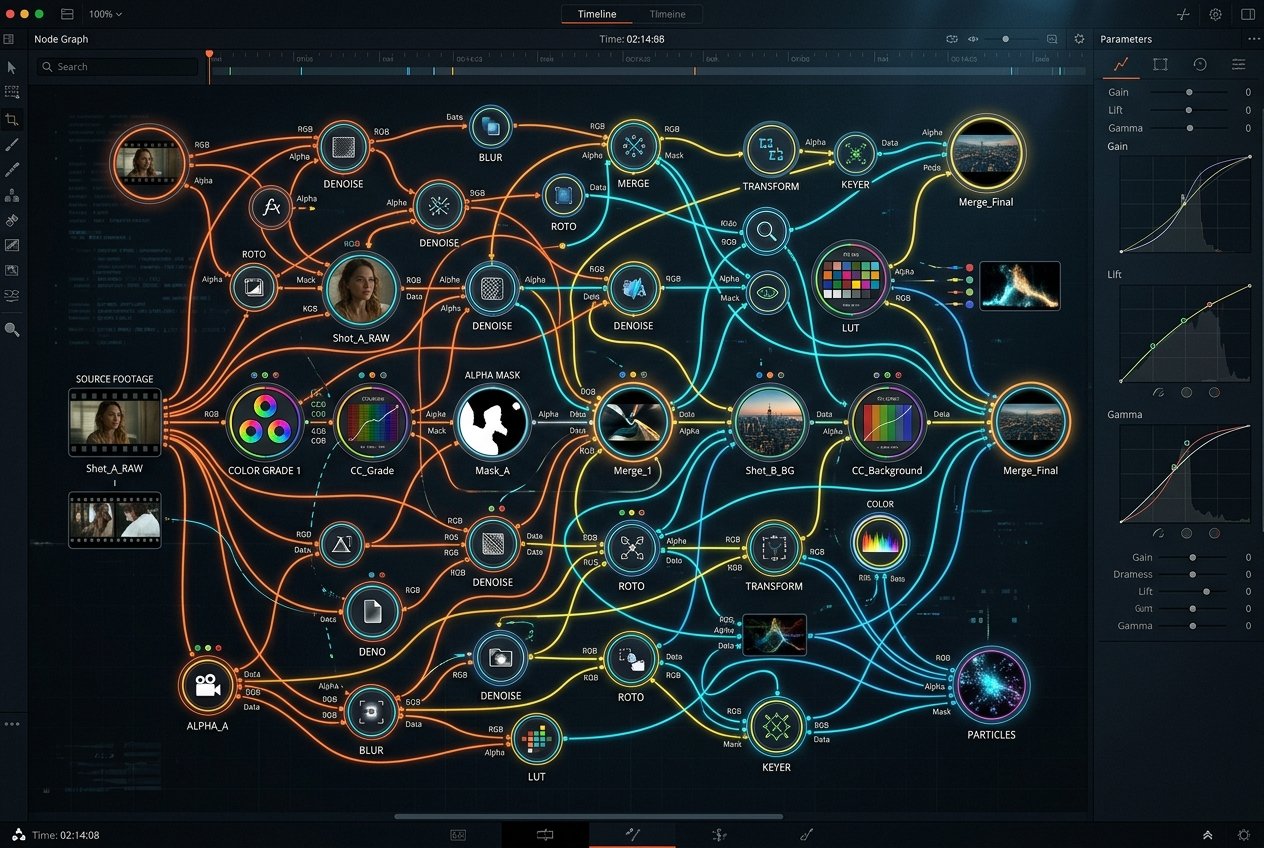
For students learning compositing, the conversation usually starts and ends with Nuke — the industry standard at most large VFX houses. But Blackmagic Fusion, especially since being bundled free with DaVinci Resolve, has quietly become a genuinely capable alternative worth understanding, particularly for students building a career outside the largest studios.
Node-based compositing, like Nuke
Fusion shares Nuke's core philosophy: compositing is built as a network of nodes rather than a stacked layer system (the approach After Effects uses). This node-based approach gives compositors more precise, non-destructive control over complex shots — multiple render passes, rotoscoping, keying, and color work can all be wired together and adjusted at any stage without rebuilding the whole comp. Because the underlying logic is so similar to Nuke, skills largely transfer between the two, making Fusion a reasonable training ground for students who'll eventually work in a Nuke-based studio pipeline.
Why it's spreading
Fusion's biggest practical advantage is accessibility: it ships free (in a capable version) with DaVinci Resolve, one of the most widely used editing and color-grading tools in the industry, and Blackmagic's hardware (cameras, capture devices) has become common on independent and mid-budget productions. This has made Fusion the default compositing tool for a growing tier of studios, freelancers, and content creators who don't have the budget or need for Nuke's licensing costs, particularly in advertising, broadcast, and independent film work.
Where it fits in a real pipeline
Because Resolve integrates editing, color grading, and Fusion's compositing in one application, smaller studios and freelance VFX artists can handle an entire post-production pipeline — cut, comp, and grade — without switching software or exporting between multiple applications. For students freelancing or working with smaller production houses (a common entry point in the Indian VFX and advertising market), this all-in-one workflow is a genuine practical advantage over the traditionally separate, expensive toolchains larger studios use.
What to actually learn
Students aiming at large VFX houses should still prioritize Nuke, since it remains the standard there and appears far more often in job listings from major studios. But for students building toward freelance work, advertising, broadcast graphics, or smaller production houses — a large and growing part of India's creative economy — Fusion is a legitimate, cost-effective compositing skill to build in parallel, especially given how directly the node-based thinking transfers if a Nuke-based job comes along later.
A practical entry point
For students without access to expensive software licenses, Fusion (through DaVinci Resolve) offers a genuinely professional-grade way to build compositing skills without cost as a barrier — a meaningful consideration for students building a home practice setup alongside institute training. Pairing Resolve/Fusion fluency with Nuke exposure during training gives students credible range across both the budget-conscious and high-end ends of the compositing job market.