Skills Companies Actually Want in 2026 (Animation, VFX, Design & Gaming)
📌 Table of Contents
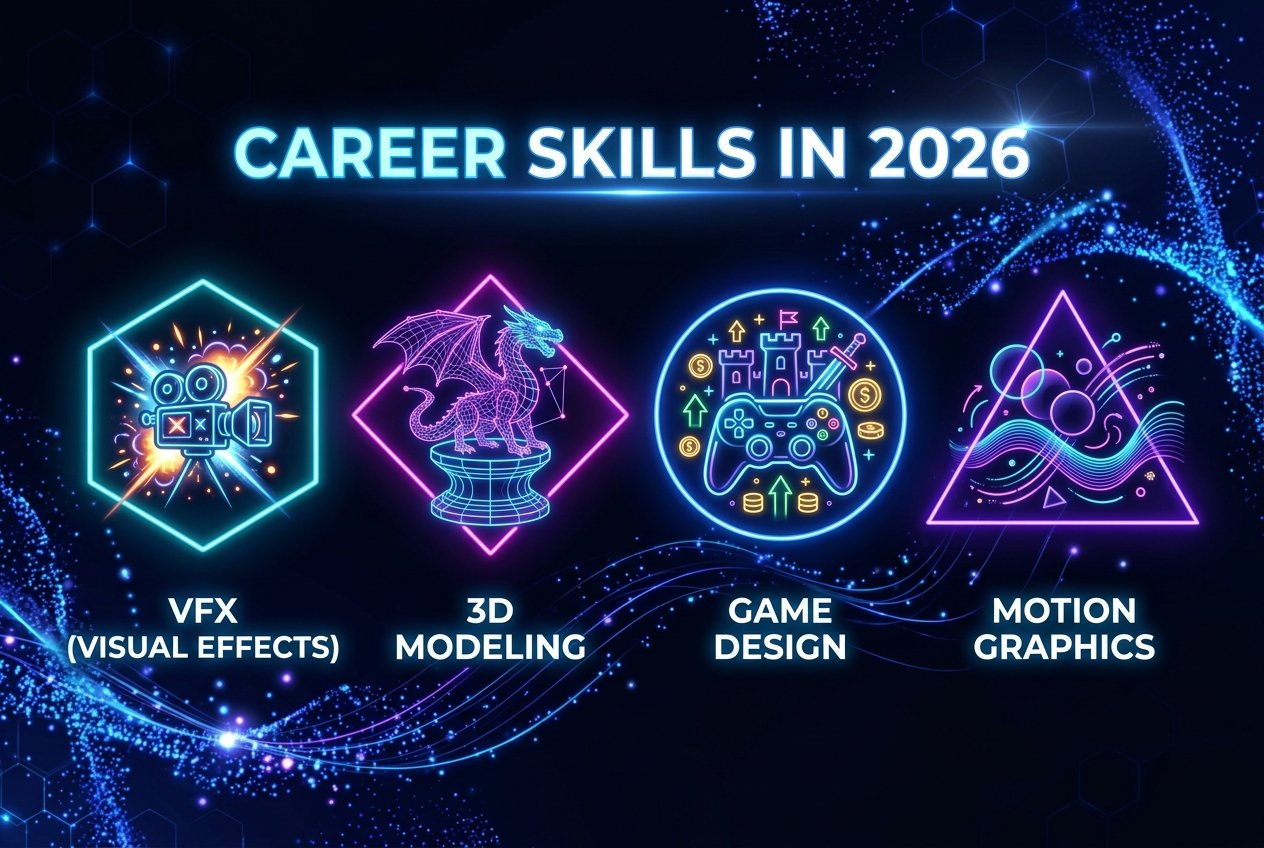
Job postings and industry hiring reports from 2026 point to a consistent pattern across animation, VFX, game development, and design: companies are no longer just hiring for software proficiency — they're hiring for a specific combination of traditional craft plus AI fluency, and the two increasingly aren't separable.
Traditional fundamentals haven't gone away
Despite the AI conversation dominating headlines, the underlying skills studios test for in portfolios and interviews remain largely unchanged: solid understanding of animation principles, strong drawing or modeling fundamentals, color and composition sense, and — critically — the ability to take direction and iterate based on feedback. What's changed is that these fundamentals are now treated as a baseline expectation rather than a differentiator; nearly every applicant is assumed to have them.
AI tool fluency is now a genuine differentiator
Across animation, VFX, and design job postings, familiarity with generative AI tools relevant to the specific discipline — Runway or Kling for video, Stable Diffusion or Firefly for image generation, Audio2Face-style tools for facial animation — increasingly appears as a listed skill, not because studios want to replace traditional craft with AI, but because they want artists who can accelerate their own workflow using these tools while maintaining creative quality and judgment.
New hybrid roles are emerging
Job titles like "AI Animator," "AI-assisted Designer," and "prompt engineer" (specifically for creative/visual contexts) have started appearing in Indian and international job listings — roles that didn't exist even two to three years ago. These positions specifically look for people who combine traditional creative training with the ability to direct, prompt, and refine AI-generated output, positioning candidates who can do both meaningfully ahead of pure traditionalists or pure AI-tool operators.
Software and engine skills in highest demand
Unity and Unreal Engine remain the most requested tools for game and XR roles, Blender and Maya dominate 3D art listings, and After Effects with Cinema 4D remain standard for motion design. Real-time engine skills specifically (not just offline rendering) are increasingly requested even outside pure gaming roles, reflecting growth in virtual production and real-time visualization work.
Soft skills that keep showing up
Beyond technical skill, employers consistently cite the ability to work within an established pipeline or style guide, hit deadlines reliably in fast-turnaround environments (especially relevant given streaming platforms' volume-driven production schedules), and communicate clearly about creative decisions — since most production work happens in teams, not in creative isolation.
What students should prioritize
The clearest signal from 2026 hiring patterns is that studios aren't choosing between traditional skill and AI fluency — they're specifically seeking both together. Students building a portfolio should demonstrate strong fundamentals first, then visibly show how they've integrated relevant AI tools into their actual workflow, not as a separate novelty piece but as part of how they work.