OpenUSD Explained: The Standard Reshaping 3D Pipelines
📌 Table of Contents
OpenUSD (Open Universal Scene Description) is the open-source, industry-governed evolution of Pixar's original USD framework — and it's rapidly becoming the closest thing the 3D industry has to a universal file standard, similar to what PDF did for documents or MP4 did for video.
From Pixar tool to industry standard
Pixar originally built USD to solve its own internal production problems and open-sourced it in 2016. As adoption grew across studios and software vendors, a group of major industry players — including Pixar, NVIDIA, Apple, Adobe, and Autodesk — formed the **Alliance for OpenUSD (AOUSD)** to formally standardize the specification, rather than leaving it as a single company's proprietary tool. This governance shift is a big part of why OpenUSD adoption has accelerated: studios can invest in it without worrying it's controlled by one vendor's roadmap.
Why it spread beyond entertainment
OpenUSD's design — describing complex 3D scenes efficiently, non-destructively, and collaboratively — turned out to be exactly what industries outside VFX and animation needed too. Manufacturing, robotics, and architecture have adopted it heavily for **digital twins**: precise virtual replicas of real factories, products, and environments used for simulation and planning. NVIDIA's Omniverse platform, built entirely around OpenUSD, is now used by companies like Siemens, Mercedes-Benz, and Foxconn for exactly this purpose, meaning OpenUSD skills increasingly transfer between entertainment and industrial applications.
Generative AI is being built on top of it
NVIDIA and others have released AI models specifically trained to generate and manipulate OpenUSD content — tools that can produce OpenUSD-compliant 3D scenes from text prompts, automatically apply physically accurate materials, or answer natural-language queries about a 3D scene's structure. This positions OpenUSD not just as a file format but as the data layer that a growing wave of 3D-focused AI tools are being built around.
What this means for students
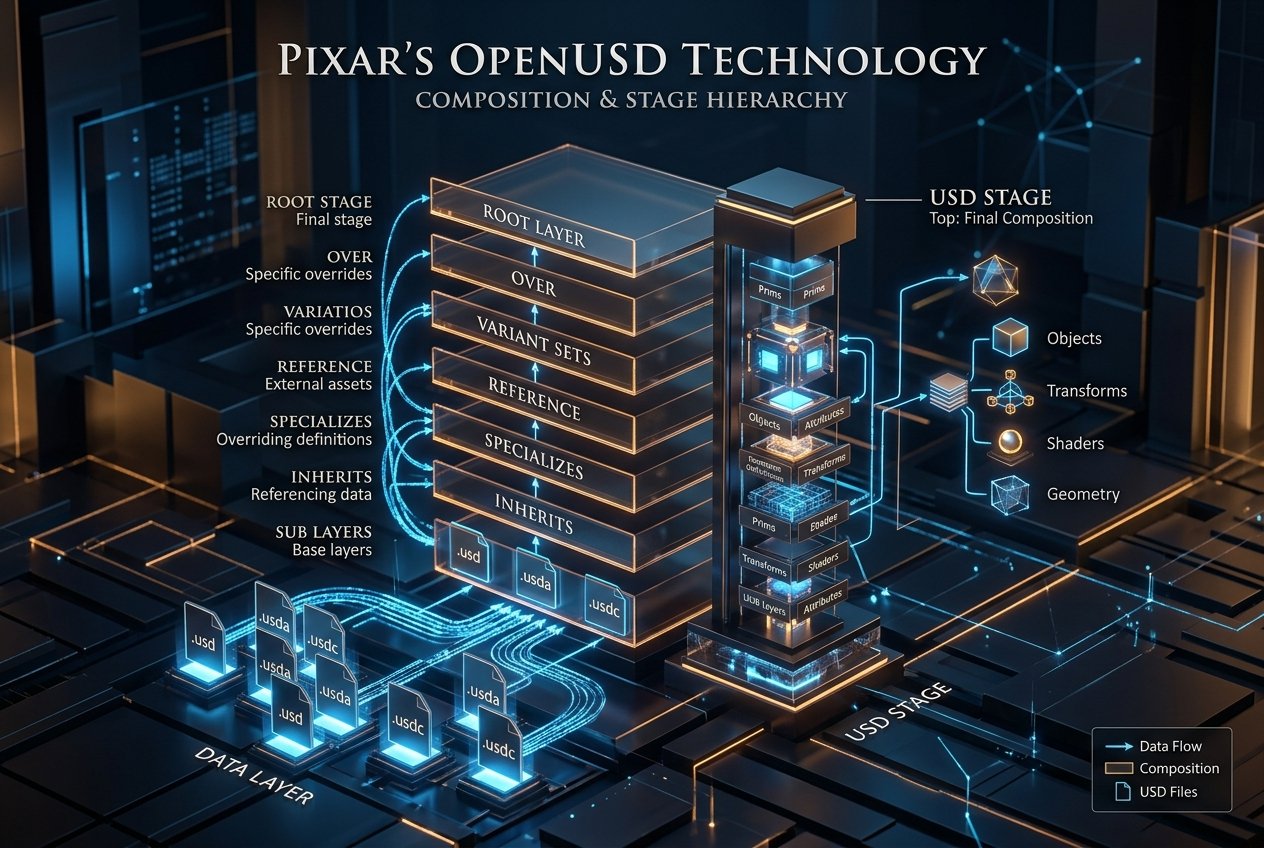
OpenUSD isn't something a beginner needs to learn as a first skill — foundational modeling, texturing, and lighting knowledge still comes first. But for students aiming at VFX, look-development, lighting, or pipeline-focused roles, having conceptual fluency with OpenUSD — understanding composition, layering, and referencing — is increasingly expected at mid-level and senior positions, and studios are more likely to view a portfolio built with awareness of these concepts (even in tools like Houdini's Solaris context) as pipeline-ready rather than purely artistic.
The practical takeaway: treat OpenUSD literacy as a specialization to build once fundamentals are solid, not a replacement for them — but one worth prioritizing over other technical electives given how fast industry adoption is moving.