Neural Rendering: When AI Learns to Render Scenes
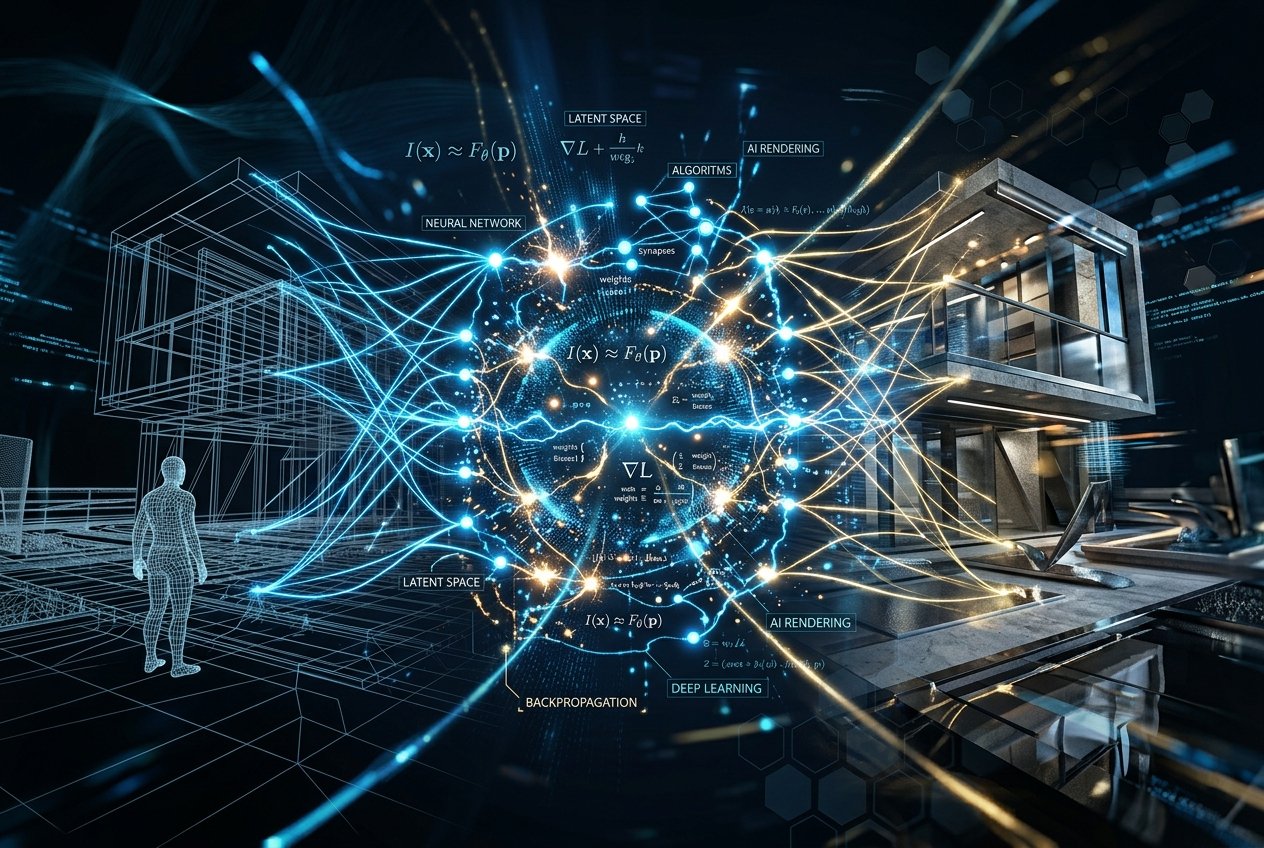
Neural rendering represents a genuinely different approach to generating images than traditional computer graphics — and it's beginning to reshape how visual content gets produced.
**Traditional rendering vs. neural rendering.** Conventional rendering calculates images by simulating light physics against defined 3D geometry and materials — a precise, computationally heavy process. Neural rendering instead uses AI models trained on visual data to generate or enhance imagery, learning patterns of light, shadow, and material appearance rather than explicitly calculating them.
**Where neural rendering is already making an impact.** AI-assisted denoising (letting renders finish faster with fewer samples), neural upscaling (generating higher resolution output from lower resolution renders), and hybrid pipelines that combine traditional geometry with neural-generated detail are all in active production use today.
**The bigger shift on the horizon.** Emerging neural rendering techniques can generate novel viewpoints of a scene from limited source data, blurring the line between "capturing" and "rendering" a space — closely related to the Gaussian splatting techniques covered separately.
**What this means for render pipelines.** Studios are increasingly adopting hybrid approaches — traditional rendering for precise, art-directed control, neural techniques for speed and specific visual enhancement — rather than fully replacing one with the other.
**The skill this demands from artists.** Understanding both traditional rendering principles (lighting, materials, physics) and how neural techniques enhance or accelerate that process gives artists the ability to art-direct hybrid pipelines effectively, rather than treating neural tools as an opaque black box.
**Why this matters for the next generation of technical artists.** As rendering pipelines increasingly blend traditional and neural techniques, artists who understand both the underlying physics and the AI-driven acceleration layered on top will be best positioned to troubleshoot and creatively direct these hybrid systems.
Nuevopixels' rendering and VFX curriculum builds strong traditional rendering fundamentals first, then introduces neural and AI-assisted rendering tools as an accelerating layer — ensuring students understand the "why" behind the tools they're using, not just the button to press.
---