FX Artist Roadmap: From Beginner to Job-Ready
FX artistry — simulating fire, smoke, water, destruction, and other dynamic phenomena — is one of the most technically demanding specializations in VFX. Here's a realistic path from beginner to job-ready.
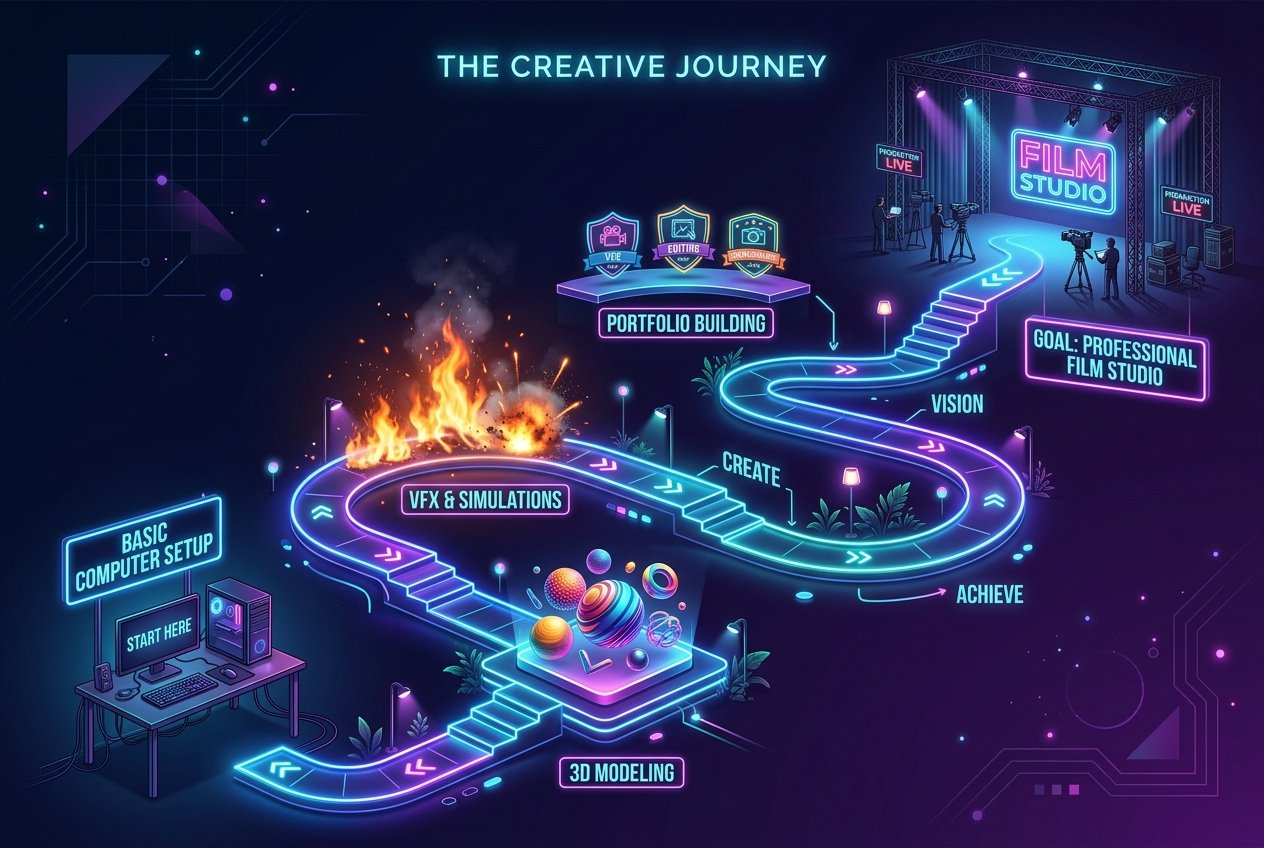
**Stage 1: Foundational VFX and compositing literacy (Months 1–3).** Before diving into simulation work, build a general understanding of the VFX pipeline and basic compositing — FX artists need to understand how their simulated elements will be integrated into final shots.
**Stage 2: Core physics and simulation principles (Months 2–5, overlapping).** Learn how real-world fire, smoke, water, and destruction actually behave — studying reference footage obsessively builds the intuition needed to recognize when a simulation looks physically wrong.
**Stage 3: Houdini fundamentals (Months 4–9).** Begin dedicated Houdini training — its procedural, node-based approach to simulation is the industry standard for FX work at film and high-end game cinematic scale. Expect this stage to take real time; Houdini's learning curve is genuinely steep.
**Stage 4: Specific simulation types (Months 7–12).** Build depth in specific simulation categories — pyro (fire/smoke), fluid dynamics, rigid body destruction, particle systems — rather than trying to master everything shallowly. Most working FX artists develop a specialty within simulation itself.
**Stage 5: Shot integration practice (Months 9–13).** Practice integrating simulations into real plates or rendered shots — a technically perfect simulation that doesn't integrate believably with lighting and camera isn't shot-ready, and integration skill is what studios actually evaluate.
**Stage 6: Reel building and specialization (Months 11–15).** Build a focused demo reel showing 3–4 strong, well-integrated simulation shots rather than many rough ones — reel quality and shot integration matter far more to hiring supervisors than simulation complexity alone.
**What studios look for.** A reel demonstrating both technical simulation control and a strong eye for how effects should look and integrate into real footage — the combination of technical and artistic judgment is what separates hireable FX artists from technically capable ones.
Nuevopixels' VFX program follows this progression with dedicated Houdini and simulation coursework, building toward genuinely portfolio-ready FX specialization by graduation.
---