Digital Humans: The New Frontier for 3D Animators
📌 Table of Contents
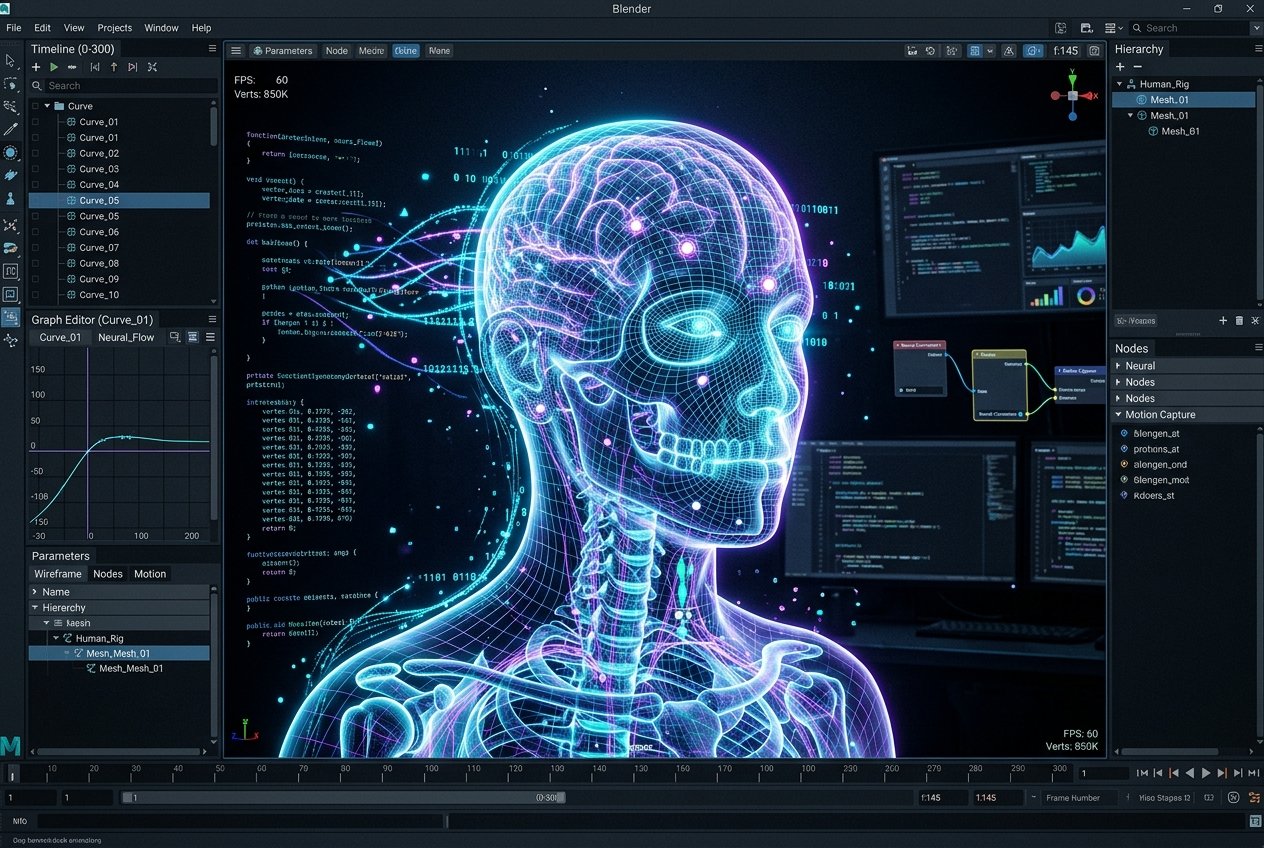
Digital humans — photorealistic or stylized virtual characters that can act, speak, and emote convincingly — have moved from research labs into mainstream production. Studios using tools like Epic Games' MetaHuman, NVIDIA's ACE and Audio2Face, and Unreal-based virtual production pipelines now build believable digital actors faster than ever, and the demand for artists who can rig, animate, and direct them is growing across film, games, advertising, and virtual influencers.
Why digital humans matter now
Three things converged to make this a real career track rather than a novelty. First, real-time engines like Unreal now render skin, hair, and eyes convincingly at interactive frame rates. Second, AI-driven facial and voice systems can generate a base layer of lip-sync and expression from audio alone, cutting weeks of manual keyframing. Third, brands and studios increasingly want "always-on" virtual hosts, spokespeople, and NPCs — meaning a single well-built digital human can be reused across ads, games, and live events instead of being a one-off VFX shot.
What the job actually involves
Building a digital human is a pipeline, not a single skill. It typically spans:
- **Modeling and texturing** the face and body with production-grade detail (pores, subsurface scattering, micro-wrinkles)
- **Rigging** a facial system capable of the full range of human expression, usually blendshape-based
- **Animation direction** — either through motion/performance capture or AI-assisted generation, followed by hand-polish
- **Real-time integration** into engines like Unreal so the character can be driven live in virtual production or interactive experiences
Most studios split this work across modeling, rigging, and animation specialists who share a common pipeline rather than expecting one artist to do it all.
Skills worth building
Understanding topology for deformation, facial anatomy, and blendshape systems still forms the foundation — AI tools accelerate output but don't replace an eye trained on how a real face moves. Familiarity with MetaHuman Creator, basic knowledge of motion-capture data cleanup, and comfort working inside a real-time engine (rather than only offline renderers) are increasingly expected. Knowing how to art-direct an AI-generated performance — spotting where it looks "off" and correcting it — is becoming its own valuable skill.
Where this leads
Digital human specialists work across game studios (NPCs and cinematics), advertising agencies (virtual spokespeople), broadcast (virtual anchors), and increasingly enterprise (AI-driven customer service avatars). It's one of the few 3D animation specializations where film, gaming, and corporate work all compete for the same talent pool — which tends to mean stronger pay for artists who can demonstrate a polished digital human in their reel.
For students building a 3D animation portfolio, one well-executed digital human shot — modeled, rigged, and performed — can carry more weight than a dozen generic character clips, because it proves you can handle a full production pipeline end to end.