AI Motion Design: What's Actually Practical Right Now
📌 Table of Contents
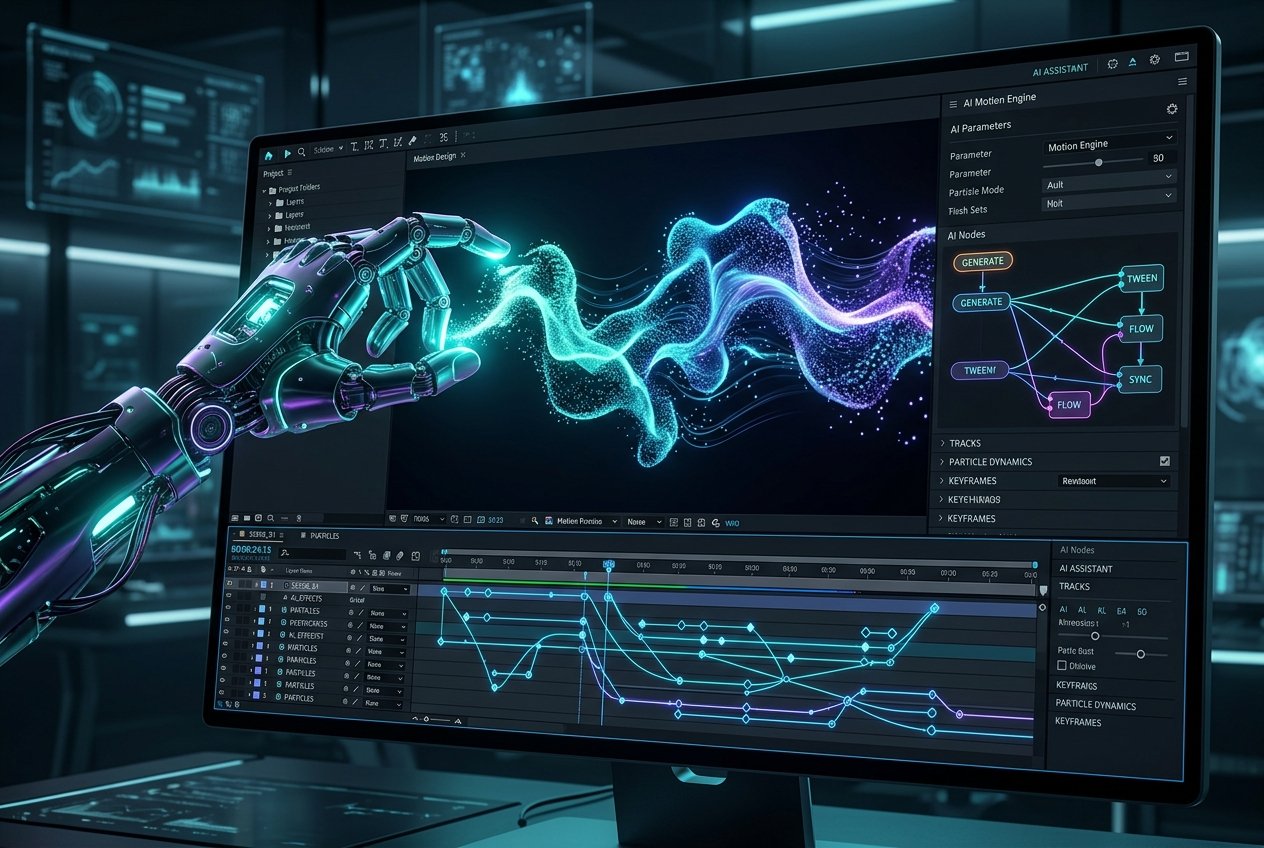
AI is changing motion graphics workflows in real, measurable ways — but the changes are more incremental and tool-specific than the "AI will generate your whole video" narrative suggests. Understanding exactly where AI fits today gives students a much more useful picture than either dismissing it or over-hyping it.
Where AI genuinely speeds up motion work
AI-assisted rotoscoping and object tracking (built into tools like After Effects' Roto Brush) can cut hours off isolating a subject from background footage — a task that used to be one of the most tedious parts of a motion designer's job. AI-driven auto-captioning and kinetic type timing tools can generate accurate, synced base timing from an audio track automatically, letting designers focus on stylistic choices rather than manual keyframe entry. Generative AI video tools (Runway, and similar platforms) can now produce short background plates, texture elements, or abstract motion backgrounds that would previously have required either stock footage licensing or from-scratch animation.
Where AI still struggles
Precise, brand-consistent animation — matching an exact logo animation style, hitting frame-accurate sync with a soundtrack, maintaining consistent character or element appearance across a full sequence — remains difficult for pure AI generation and still requires traditional keyframe animation and hand-finishing. AI-generated motion also frequently struggles with clean, readable typography integration, meaning kinetic type work in particular still leans heavily on traditional After Effects skills.
The shift: from creation to direction and finishing
For working motion designers, the practical shift isn't "AI does the work now" — it's that a larger share of a project's time moves toward directing AI-generated elements (selecting the right output from many generated options, refining prompts) and finishing work (compositing, color-matching, precise timing adjustments) rather than building every element from a blank timeline. This mirrors similar shifts happening in animation and 3D modeling, where AI accelerates the rough pass and human skill focuses on judgment and polish.
What clients and studios actually want
Studios and agencies adopting AI motion tools are doing so primarily to speed up production timelines and handle higher content volume (especially for social media, where output needs are constant), not to reduce headcount for skilled creative direction. Motion designers who can efficiently combine AI-generated elements with strong traditional compositing and animation finishing are becoming more valuable, not less, because that combination is exactly what lets a small team match the output volume that used to require a much larger one.
What students should prioritize
Traditional After Effects fundamentals — keyframing, easing, compositing, typography — remain the foundation that makes AI-assisted work usable rather than generic. Layer AI tool fluency on top of strong fundamentals, not instead of them.