Procedural Content Generation: Building Worlds Algorithmically
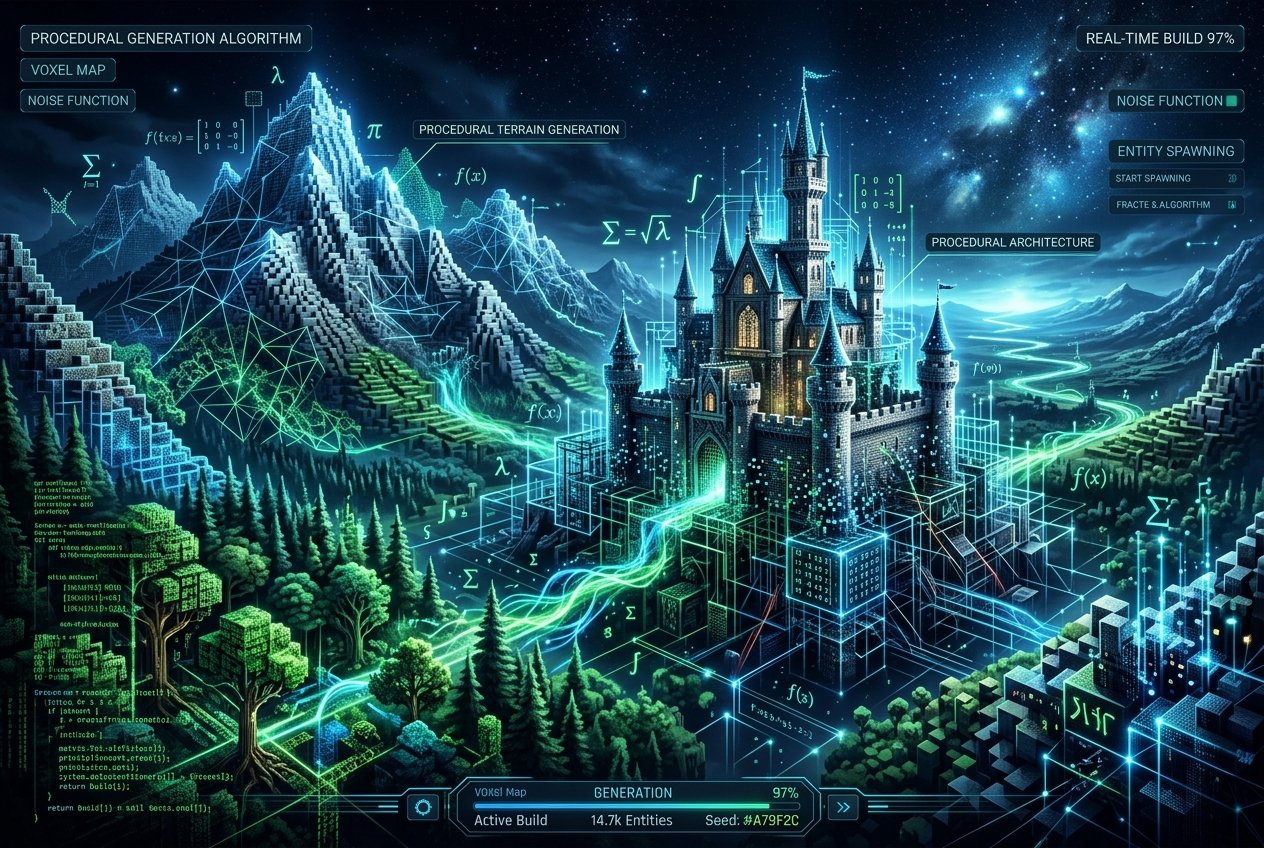
Procedural content generation (PCG) uses algorithms to automatically create game assets, levels, or entire worlds — a technique that's existed for decades but has become dramatically more sophisticated and widely adopted in recent years.
**What it actually does.** Instead of manually placing every tree, rock, or building, PCG systems use rules and algorithms to generate content automatically — from entire procedurally generated landscapes to algorithmically varied prop placement that avoids repetitive, hand-placed-looking environments.
**Where it's used in modern production.** Open-world games rely heavily on PCG to populate massive environments efficiently, architectural visualization uses procedural tools to rapidly generate building variations, and film/animation increasingly uses procedural systems (particularly within Houdini, as covered in our Houdini careers piece) for complex environments like cities, forests, and crowds.
**The difference between PCG and AI generation.** Procedural generation uses defined algorithmic rules set up by an artist or technical designer — predictable, controllable, and art-directable. This is distinct from AI generative tools, which produce content based on learned patterns from training data — the two are increasingly used together, but represent different underlying approaches.
**Why PCG remains valuable even as AI tools grow.** PCG systems give artists precise, rule-based control over variation and scale — useful specifically because the output stays within defined creative parameters, unlike more unpredictable AI generation, making it ideal for large-scale environment work needing consistency.
**The skill this demands.** PCG work sits at the intersection of technical and artistic thinking — building the underlying rule systems (often visually, through tools like Houdini's node-based system) requires understanding both software logic and what makes a "natural-looking" random result actually look natural.
**Career relevance.** Technical artists and environment artists with PCG skills are increasingly valuable for large-scale game and virtual production work, where manually building every asset simply isn't feasible at the scope modern productions require.
Nuevopixels' Game Design and VFX programs introduce procedural techniques through Houdini and engine-based tools, giving students the technical-artistic hybrid skillset PCG work demands.
---