Mixed Reality: Where Digital Content Meets the Physical World
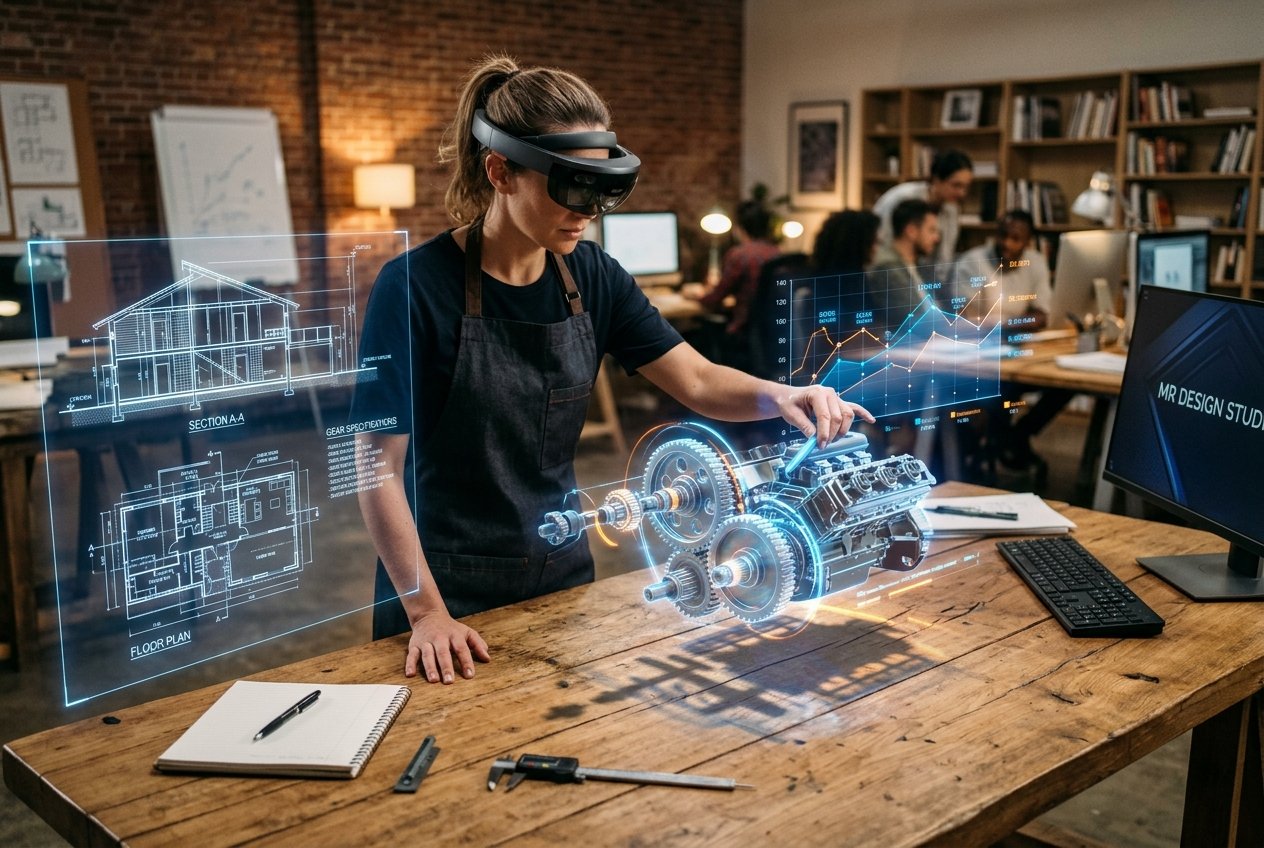
Mixed reality (MR) represents the most technically demanding point on the XR spectrum — genuinely blending digital and physical space rather than simply overlaying or replacing it, and it's creating a distinct design discipline of its own.
**What separates MR from basic AR.** Simple AR overlays digital content onto a camera view without deep spatial understanding — a filter sits on top of your face regardless of what's behind you. MR requires the device to understand real-world geometry deeply enough that digital objects can be occluded by real furniture, cast realistic shadows, and respond to real-world lighting conditions convincingly.
**Where MR is currently used.** Enterprise design and collaboration tools letting teams manipulate 3D models as if physically present in the same room, industrial training applications overlaying instructional digital content onto real equipment, and creative visualization tools for architecture, product design, and film previsualization.
**Why MR design is genuinely different from other 3D work.** Designers have to consider real-world variability — different room sizes, lighting conditions, and physical obstacles — meaning MR content often needs to adapt dynamically rather than being built for one fixed, controlled environment.
**The technical skill stack.** Strong 3D modeling and real-time engine skills form the foundation, layered with specific MR development tools and spatial mapping understanding — a technically demanding but genuinely differentiated specialization within the broader XR space.
**Current career reality.** MR remains a smaller, more specialized market than VR gaming or basic AR, concentrated heavily in enterprise, industrial, and design visualization applications rather than mainstream consumer entertainment — a niche with real depth for artists genuinely interested in the technical challenge.
**What this means for students.** MR is a strong specialization for students drawn to the technical precision of spatial computing specifically, though it currently represents a narrower career market than broader real-time 3D or game development skills.
Nuevopixels' 3D and Game Design programs build the real-time engine and spatial design fundamentals this specialization requires, positioning interested students for MR's specific, technically demanding niche.
---